
Traffic Case Records in Andrews County
Andrews Municipal Court handles City of Andrews ordinance cases along with fine-only Class C matters. Its Tyler Municipal Online Services portal lets you search and pay city citations online. The county adds two justice courts to the mix. Those precinct courts hear fine-only misdemeanors and keep their own case information. The location where the officer wrote the ticket can hint at the right court, yet the citation itself is the surest guide to where the case belongs.
A traffic court record can list a citation number, the defendant name, the alleged offense, a response or appearance date, the plea, settings, payment status, and the final outcome. Later court action may appear too. What it will not do is merge every city and county ticket into one Andrews County index. Confirm the court first. Then use that clerk's online, phone, mail, or counter channel for the Andrews County court docket entry you need.
Five Andrews Citation Search Paths
The municipal portal offers five ways to begin a citation search. That flexibility helps when the paper ticket is gone. Each option demands exact data, though. A broad name search can pull more than one match, and a vehicle search may fail if details were keyed in differently. Start with the citation number whenever you have it.
| Search Path | Fields | Best Use |
|---|---|---|
| Citation | Citation number and date of birth | Most direct match from the ticket |
| Driver license | License number and state | When the citation number is unavailable |
| Vehicle | Plate number and state | When the cited vehicle data is known |
| Name | Last and first name, date of birth | Personal citation lookup |
| Business | Business name | Citation issued in a business name |
The official Andrews citation portal displays these search modes.
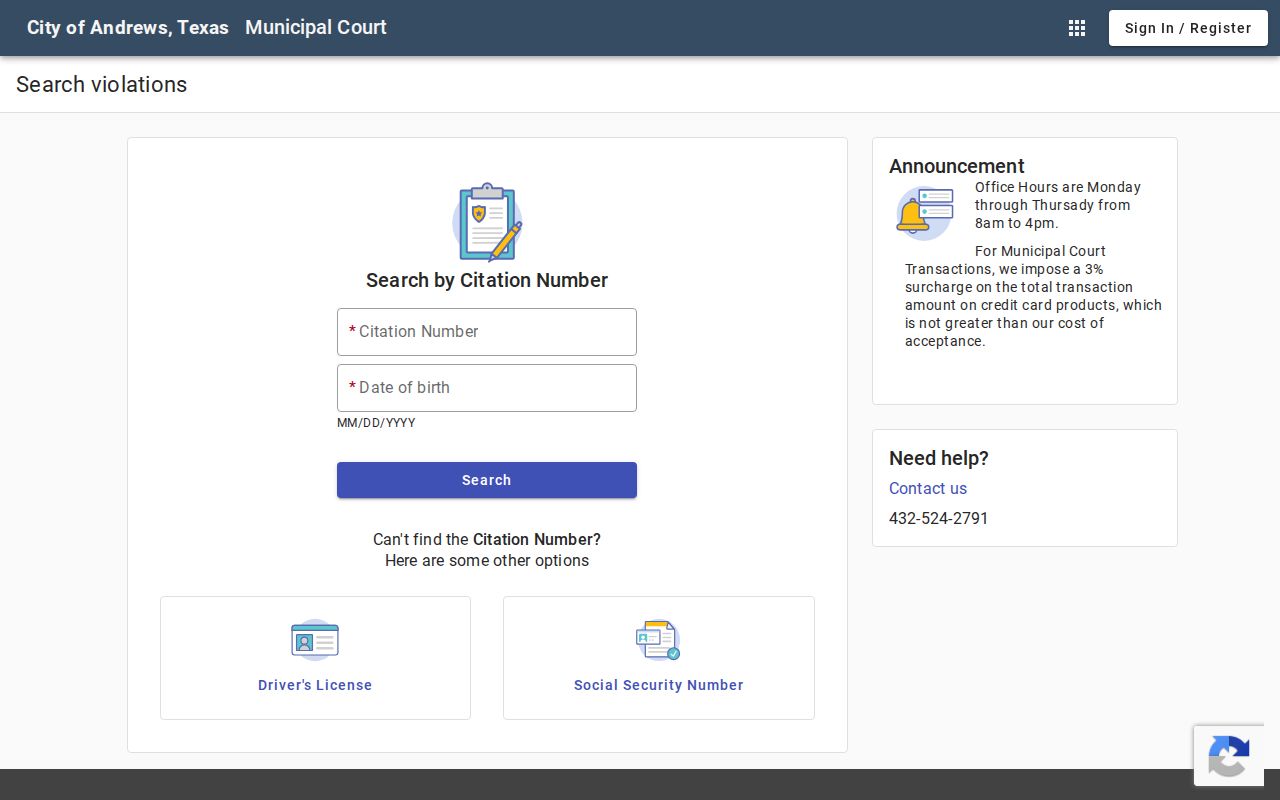
The search form itself makes one thing plain. A citation lookup is a municipal court tool, not a countywide driver-record product.
Andrews County Traffic Ticket Lookups
Any lookup should protect the response deadline printed on the ticket. An online result helps confirm a record, but a failed search extends nothing. New citations can take time to reach the court's docket. If the ticket will not appear, use the court name on the paper. Call or visit that clerk.
- Read the citation and identify Municipal Court, Justice Court Precinct 1, or Precinct 2.
- For a city ticket, search the municipal portal by citation number and birth date.
- Try the license, vehicle, name, or business path if the citation number is unavailable.
- For a justice-court matter, contact the named precinct office by phone or at its counter.
- Ask the court to confirm the response date, current setting, plea status, balance, and allowed response channels.
- Keep proof of any filing, plea, or payment submitted to the court.
The state Office of Court Administration keeps no individual Andrews County citation files. re:SearchTX is not the normal source for these municipal or justice traffic matters either. The issuing court remains the channel that counts.
Municipal or Andrews County Justice Court
A city citation and a justice-court citation are separate records from day one. Municipal Court belongs to City of Andrews ordinance and fine-only Class C cases. It runs on Tyler Municipal Online Services, though city court staff still hold the files. The two justice courts are county precinct courts for fine-only misdemeanors within their own jurisdiction. No countywide JP citation portal exists. So their clerks are the direct route to a precinct docket.
A Texas Department of Public Safety traffic stop does not reveal which precinct got the case. Trust the court box and contact details printed on the ticket. Municipal and justice courts do share a youth-diversion plan. But that plan expressly excludes traffic offenses.
Traffic Court Dates in Andrews County
The citation shows a response or appearance date and names the court. That date may not be a trial date. It can simply mark the deadline to respond, enter a plea, or appear for an initial setting. Check the court record before you rely on it. Look there for later settings, continuances, or other changes. The municipal portal and the court office serve city matters. Each justice court confirms its own docket.
| Citation Number | Enter the exact identifier printed on the ticket, such as citation number on notice; no universal local format was documented. |
|---|---|
| Assigned Court | Municipal Court or the named justice-court precinct. |
| Response Date | The deadline printed on the citation; it may differ from a trial setting. |
| Setting | A scheduled appearance, hearing, or trial after the court processes the response. |
| Status | Pending, disposed, paid, or another status confirmed by the court. |
If a date looks wrong or a reset was requested, verify the current entry with the clerk. A request is not a granted continuance, so keep any written order or confirmation.
Verify Andrews Court Details
The city budget, the state directory, and the portal differ. They do not list contact details the same way. That conflict makes direct verification worth the effort before an appearance or payment. Use the contact information on the citation, or details confirmed through the official court service. An address copied from an old notice should never stand in for a current court record.
Ticket absent online? Recheck the citation number and court. Then call the named court before the response date. Ask whether the citation has been filed and what response method preserves the deadline.
Justice Court offices sit at 215 NW 1st Street. Precinct 1 is in Suite 3; Precinct 2 is in Suite 4. Each precinct's direct contact is the fallback for its own cases.
Paying a Ticket vs Fighting It
Paying and contesting are not interchangeable moves. A payment generally resolves the charge through a plea and disposition the court accepts. Contesting takes a not-guilty plea and a later trial or hearing. A portal that takes your money still does not replace the court's instructions for requesting a contested setting, deferred disposition, or any other option.
| Point | Paying | Contesting |
|---|---|---|
| Court response | Follow the court’s payment and plea terms | Enter a not-guilty plea by an allowed method |
| Next event | Case may be disposed after acceptance | Court assigns a hearing or trial setting |
| Proof to retain | Receipt and disposition information | Filed plea and setting notice |
| Questions | Ask about total due and processing charge | Ask about deadlines and appearance rules |
Failure to appear or pay: A court may report an unresolved case through the Texas FTA/FTP program and may issue court process allowed by law. Contact the court that reported the matter. DPS says clearance may take several business days after the court reports compliance.
Andrews Portal Card Surcharge
The municipal portal states that online credit-card payments carry a 3% surcharge. That charge is neither the citation fine nor a record-copy certification fee. Before submitting payment, review the court record. Check the plea effect, the total, and the terms. A card screen is a payment path only. It is never a way to contest the allegation itself.
The city budget lists municipal fee categories and traffic activity as financial measures. You cannot search for one citation with those totals. They should not be read as a live docket count either. For a specific matter, the court's case system is the source.
Two Records: Court File and Driver File
A traffic case leaves a paper trail in two places. The court keeps one file under the citation number. The Department of Public Safety keeps a separate driver file entirely. That one belongs to a state agency. The court file answers what happened in the case. It shows the plea, each setting, the disposition, and the payment status. Even an FTA/FTP question starts with the reporting court. The court itself sends the compliance data to the state.
| Court Traffic Record | DPS Driver File | |
|---|---|---|
| Kept by | Municipal or justice court clerk | Texas Department of Public Safety |
| Main purpose | Tracks one citation case and its court events | Maintains the state licensing record |
| Shows | Charge, plea, dates, disposition, amounts | State-reported license information |
| Correction route | Contact the issuing court | Use DPS procedures after court data is resolved |
Keeping the two files straight prevents a common mistake. A hit in a municipal portal is not the full state driver file, and a DPS notice never substitutes for the underlying court docket.
Clearing an Andrews FTA Report
A failure-to-appear or failure-to-pay report from DPS always traces back to one court. Start there. Ask which case is unresolved. Ask what the court requires. Ask whether a warrant or some other obligation is attached. Then meet the court's terms and hold onto the receipt or order. The court, not the driver, transmits the compliance update the state program uses. Clearance is rarely instant, according to DPS guidance. Wait several business days after the court submits compliance. Then check the state status again. If the record is still not cleared, confirm the court actually sent the update and that the identifiers match the DPS record.
Traffic Record Copy Fees
Andrews County sets no single copy-fee schedule covering traffic cases in both its municipal and justice courts. Each court sets its own charges. Ask the court that issued the citation. Find out what it bills for plain copies, certified copies, a docket search, and mailing or other delivery. Fees for a traffic court record can differ from one office to the next. One caution: the county clerk's official-record rate does not automatically carry over to a municipal citation file. Those court records sit with a different office.
| Item | Documented Amount | Action |
|---|---|---|
| Municipal online card payment | 3% surcharge | Review the total before submitting |
| Plain traffic-case copy | Not documented uniformly | Ask the issuing court |
| Certified traffic-case copy | Not documented uniformly | Confirm certification and cost |
| FTA/FTP reimbursement fee | Set by Texas law and court process | Get the current amount from the reporting court |
When you ask for records, name the item: the citation number, the docket sheet, the disposition, or a signed order. Say whether you need it certified. A copy request stands apart from paying the citation itself.
Andrews Traffic Counts Need Context
Numbers about traffic in the City of Andrews budget measure administrative performance. They measure nothing more. The budget notes that FY2020 traffic activity ran low under pandemic-era conditions. It also says the city avoided projections that might imply quota setting. Those figures describe municipal operations, not a searchable list of cases. One citation? Use the court record. For wider court trends, turn to the city budget or Texas Office of Court Administration statistics. Respect their reporting periods. OCA fiscal years run from September 1 through August 31. An annual label does not always match a calendar year.
Andrews Round-up Is Court Administration
The city budget applies "Round-up" to a municipal administrative effort aimed at clearing warrants. That label does not create a separate public docket. It also proves nothing about any person without confirmation from the court file. Someone searching a citation should lean on the current case record. Direct contact with the court matters too. This is especially true when an old notice or payment balance clashes with the portal. Ask the municipal court one question. Ask whether a warrant, setting, or compliance step is active in the cited case. Keep the cause or citation number handy in every contact. This program context explains why a court may run focused follow-up. It does not change the basic task: verify each record with the custodian.