
Andrews County Court Record Requests
No single office holds every Andrews County court record. The District Clerk keeps the files of the 109th Judicial District Court. That court covers district civil, family, and felony criminal cases. County-court civil, probate, guardianship, juvenile, mental-health, and misdemeanor files sit with the County Clerk. Justice courts each keep their own precinct cases. The City of Andrews court office handles municipal matters. Before you call, gather the cause number, party name, court, record type, and a rough date range.
You have several ways in. There is a county-facing Tyler index. re:SearchTX works when the court participates and the case type qualifies. The county archive offers selected published dockets. Plain contact with the right clerk also works. Requests work at the counter, by phone to confirm custody and cost, or by mail with enough detail for staff to find the file. The county posts no case-copy request form of its own. Confirm the required fields with the clerk before you send payment.
- Identify the court and case type before choosing a clerk.
- Gather the cause number, party name, date range, and exact document title.
- Check the available online index or archive for a reference.
- Call or visit the custodian when the file or document is absent.
- State whether a plain or certified copy is needed, then confirm cost and delivery.
Note: re:SearchTX excludes criminal records, and local coverage depends on court integration.
Two Andrews County Record Keepers
Do not assume the clerk named on a county webpage keeps your case. District and county jurisdiction are two different things. A filing from the 109th Judicial District Court belongs to the District Clerk, even though the County Clerk handles plenty of court records too. Misdemeanor county-court files, probate matters, and guardianship records all go to the County Clerk. Fine-only cases stay with the justice or municipal court that heard them.
| Custodian | Typical Records | Contact Route |
|---|---|---|
| District Clerk | District civil, family, felony criminal | 201 N Main Street, Room 102; 432-524-1417 |
| County Clerk | County civil, probate, guardianship, juvenile, mental health, misdemeanor | 215 NW 1st Street, Suite 121-A; 432-524-1426 |
| Justice Courts | Precinct civil and fine-only misdemeanor matters | Suites 3 and 4 at 215 NW 1st Street |
| Municipal Court | City ordinance and fine-only Class C matters | City court office and citation portal |
Kinds of Andrews County Court Records
Think of a docket as a chronological index of activity. The short entry only names a document. The filing itself may hold the facts, the request, the ruling, or a signature. Ask for the specific item whenever you can. Broad requests cost staff more time and may pull in material that is restricted or needs redaction.
- Docket sheets and case summaries
- Petitions, complaints, answers, and motions
- Signed orders, judgments, and dispositions
- Notices, returns, and service records
- Plain or certified copies of eligible documents
- Transcripts, when separately created and available
- Docket
- The ordered register of filings, settings, and rulings.
- Plain copy
- A reproduction without formal clerk certification.
- Certified copy
- A copy authenticated by the custodian.
- Transcript
- A written record of spoken proceedings, distinct from the clerk file.
Andrews County Record Index Limits
The county describes its Tyler service as an index, and the library-catalog comparison fits. It points you toward records. What you see on screen is not the official document itself. Newly filed official-record material normally posts after two to three business days. The county says so. That helps with planning. It does not promise every court event or filing follows the same schedule. The official Tyler portal source shows the public-service disclaimer and the acceptance step.
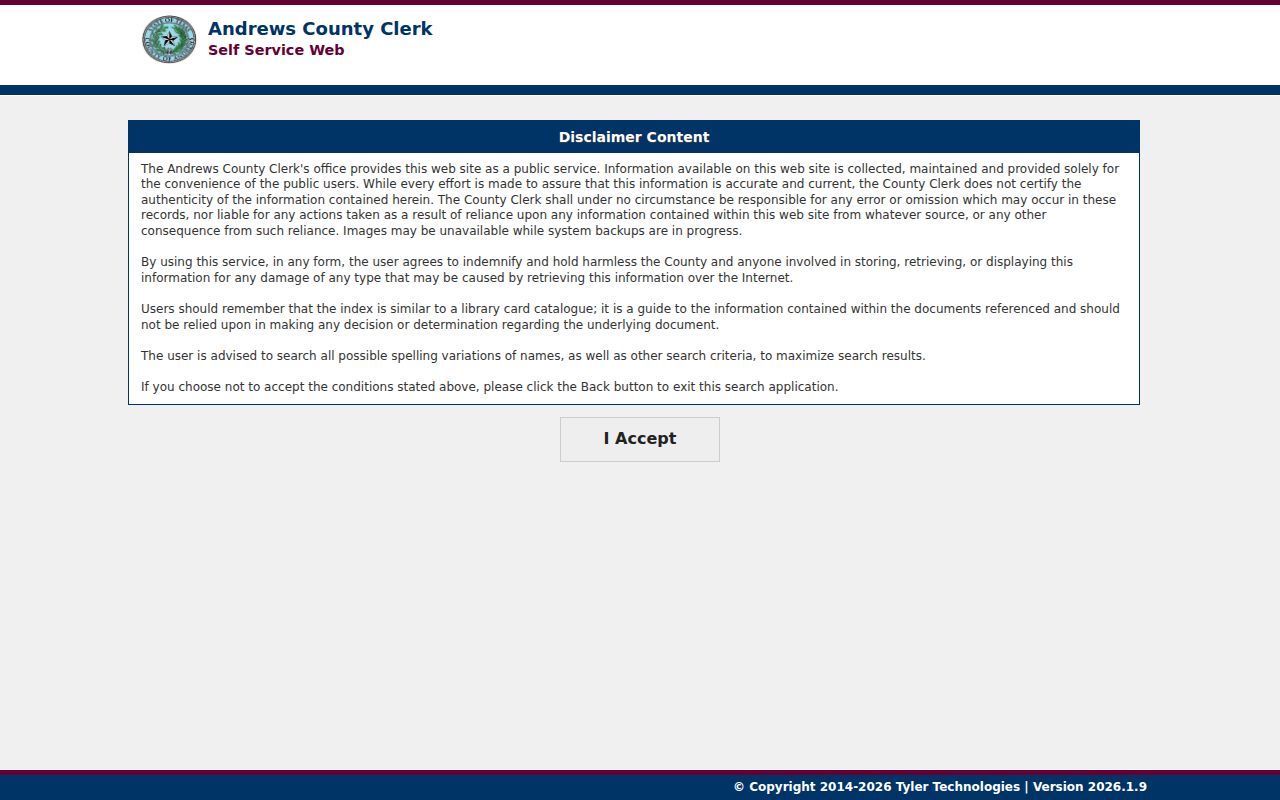
The notice explains the practical lesson. Use a portal result to find a record, then check it against a clerk-issued copy whenever accuracy or certification matters.
No result is not proof of no case. Check the court level, spelling, date range, and cause number. Contact the clerk because older, restricted, recent, or nonintegrated material may not appear.
Court Records: What They Contain
A strong request names both the case and the item. Court records may show the parties, the court, a cause number, filing dates, document titles, settings, orders, and a final disposition. Some of that appears only on a docket sheet. The real detail lives in the filed document. Ask for the specific item whenever you can. Expect personal identifiers to be removed before release.
| Cause Number | The court’s main file key; include it whenever known. |
|---|---|
| Parties | Names used to identify the case, subject to privacy limits. |
| Filing Entry | Date and title for a pleading, motion, notice, or order. |
| Setting | A hearing, trial, conference, or docket call. |
| Disposition | The recorded outcome, such as judgment, dismissal, plea, or sentence. |
| Document Image | The filed item itself, if public and available. |
A case index can help you find a cause number, but it is no substitute for a signed order. Want to know what the judge ruled? Ask for the order. Want to trace the sequence of events? The docket sheet may be enough on its own.
Andrews County Records Since 1881
The County Clerk says its records reach back to 1881. Age alone does not make a record open or online. The office warns that some older material is closed. Andrews County history spans early settlement, the 1910 county-seat election, agriculture, and the oil era. Older property, probate, and civil files may sit in storage with indexes unlike anything used for newer electronic cases.
Check the county archive. It holds selected schedules and docket artifacts. For an official historical case record, give the clerk names, an approximate year, and the case type. Include any known volume, page, or cause number. Staff can tell you whether the record exists. They can also say where it is stored and which limits apply.
Copy Fees and Certification
The County Clerk publishes an official fee structure for record copies. For court-case searches or copies, contact the office directly before paying anything. The credit-card page asks for a cause number and a Bureau Code. It takes full payment only. It also warns that processing fees are nonrefundable. Never guess an amount. Have the office confirm the item, page count, certification need, and total first.
| Item | Published Amount | Practical Point |
|---|---|---|
| Plain copy | $1 per page | Confirm that this official-record rate applies to the requested item. |
| Certification | $5 per document | Added when formal clerk certification is requested. |
| Credit-card service | 3% surcharge | Confirm payment instructions before paying. |
A certified copy is not a portal printout. Certification attests that the copy matches the record the office holds. So ask your recipient what form it needs: certified, file-stamped, or another authentication.
Confirm Andrews County Costs First
Sequence matters here. Contact the County Clerk, get the amount and identifying instructions, then pay. Payment alone does not describe the record you want, a party name can match more than one file, and a cause number prevents routing errors.
Andrews County Clerk
215 NW 1st Street, Suite 121-A
Andrews, Texas 79714
432-524-1426
Monday through Friday, 8:30 a.m. to noon and 1:00 p.m. to 5:00 p.m.
District-court records take a different route: the District Clerk in Room 102 at 201 N Main Street. State the court and case type at the start of your call.
Access Rules for Court Records
Texas splits its records into two camps. Case records from actual court proceedings answer to one set of rules. Administrative judicial records answer to another. Rule 12 of the Texas Rules of Judicial Administration sets the procedure for judicial-record access. It also sets the exceptions. The Texas Public Information Act, found in Government Code Chapter 552, covers public information broadly. It cannot be used to dodge the rules that govern court case files. The custodian decides which process applies to your request.
Three terms get confused. Sealed means a record is closed to public view by legal authority. Restricted means only certain people can see it, or only through a set procedure. Redaction keeps the document public but blacks out protected data. Juvenile, mental-health, and family matters often carry extra limits of their own.
Texas access framework: Rule 12 governs judicial records; Chapter 552 is the general public-information law; Civil Procedure Rule 76a addresses sealing; Rule 21c requires sensitive-data redaction.
Note: If an index entry is public but the document itself is missing, ask the custodian. Don't assume the file was sealed.
When a Docket Row Falls Short
A docket line like "motion filed" or "order signed" only tells you when something happened. It does not give the reason or the ruling behind it. When context matters, request the named motion and the signed order together. For a final outcome, ask whether a judgment, dismissal, sentence, or other disposition document exists in the court file. Staff should confirm certification needs before preparing anything.
Federal records take a different road. Andrews County sits in the Midland-Odessa Division of the Western District of Texas, so federal dockets run through PACER or the federal clerk rather than any county portal. State appellate files live outside the trial clerk's file too. Andrews County generally falls in the Eighth Court of Appeals district.
Andrews County Filing Is Not Search
eFileTexas is how attorneys and parties deliver electronic filings to Texas courts. It is not a public Andrews County court record index. A submission that goes through also proves nothing about what the clerk accepted, indexed, or released to every search channel. Confirm what entered the case file through the docket or the clerk's record.
The gap shows up when a recent pleading should be online but isn't. Check the filing receipt if you have one. Then ask the District Clerk or County Clerk whether the item was accepted and indexed under the cause number. For a public copy, request the accepted document from the custodian. A service-provider screen is not the official court copy.