
Name-Based Case Searches
Know the court level first, then search by name. Felony cases and district civil or family matters sit with the District Clerk. Misdemeanors, probate, and guardianship stay with the County Clerk. Debt claims and evictions go to the assigned JP. City citations belong to Andrews Municipal Court, and running a name through the wrong system can produce a false zero.
- Classify the event and choose the likely district, county, JP, or municipal court.
- Use the full last name and first name when the search offers separate fields. Try documented spelling forms when needed.
- Filter by Andrews County, court level, case category, and filing period where controls exist.
- Compare likely matches by cause number, case type, filed date, and court. Do not rely on a name alone.
- Open Case Details or contact the proper clerk to verify the docket and request any needed document.
re:SearchTX accepts party or attorney terms. So do case style and docket number. Its quick guide also documents location, category, date, and sort filters, while the local archive works differently and searches only published file titles and metadata.
| Field label | Type | Required | Use |
|---|---|---|---|
| Party or attorney | Text | No | Name-based statewide query |
| Case style or description | Text | No | Known caption terms |
| Location | Filter | No | Narrow to Andrews County when available |
| Case category | Filter | No | Separate likely civil or family results |
| Date or sort | Filter | No | Order by filed date or case number |
Andrews County Court-Level Search
Andrews County has no single search box. The Texas trial-court structure from the state explains why. The 109th District Court holds general jurisdiction and is shared with Crane and Winkler. Andrews County Court, two JP precincts, and Andrews Municipal Court each fill a different lane. A court name is often the better clue.
| Court layer | Typical case | Search keeper |
|---|---|---|
| 109th District Court | Felony, district civil, family | District Clerk; statewide layer where available |
| Andrews County Court | County misdemeanor, probate, county civil | County Clerk |
| JP Precinct 1 or 2 | Fine-only offense, debt, eviction, small claims | Assigned JP office |
| Andrews Municipal Court | City ordinance and Class C citation | Municipal citation portal or city court |
Not every record is a court docket. A deed belongs in the County Clerk's official-record index. Federal cases run on a separate system, so knowing which court produced the record prevents both kinds of mismatch.
Case Number Searches
A cause number is the strongest cross-system key for Andrews County cases. Keep it exactly as the source shows it. No one format covers every district, county, JP, and municipal case, so an invented pattern would mislead. A safe pattern is CAUSE NUMBER AS FILED, paired with the court and county on the notice. Type it into the docket-number or case-number field when one is offered. Punctuation can trip the search. If the number returns nothing, follow the portal's visible format instructions or ask the clerk how its index stores the value. Give the cause number when you call or visit. A municipal citation works differently. Its citation number is a separate key, and the city's visible form also asks for date of birth. Never paste a state cause number into PACER. That system runs on federal case numbers.
Best search key: Pair the exact cause number with the court name and Andrews County.
Andrews County re:SearchTX Tools
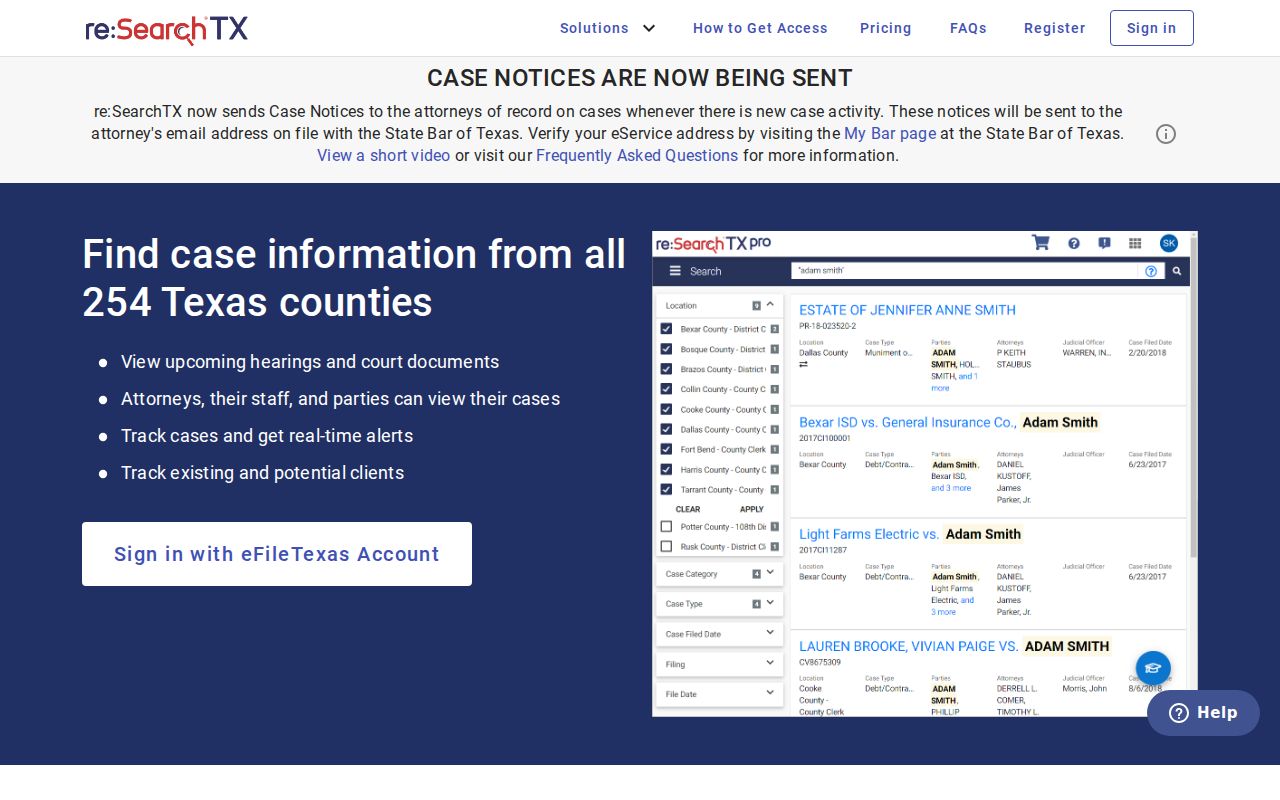
re:SearchTX is the statewide electronic court-record layer. Sign-in or registration is required. The guide describes four tabs, Cases, Filings, Text, and Hearings, plus a quick search bar beside Advanced options and a Search By choice. Results can open a Case Details page. There the case number and type, parties, attorneys, judicial officers, filings, documents, and hearings appear when those items are public and supplied. The official re:SearchTX page shows the same sign-in and search layout.
The statewide reach has limits. OCA material says criminal records are excluded, and local integration must be confirmed with each court. Wildcards work for certain judge, attorney, and party names. The guide also documents export, save-search, folder, alert, sharing, and filing actions. A saved alert is no court notice.
Case Search Results Explained
An Andrews County result is an index or docket view. It is not a verdict on every fact in the file. Read the field labels closely. A filed date may not match the day an order was signed, and an entry labeled motion means a request was filed, not granted. A reset moves a setting without resolving the case. A public document link may still require a fee, an account, or a clerk request.
| Case or Cause Number | The court-assigned key; preserve the displayed form. |
|---|---|
| Style or Parties | The caption or listed participants, subject to privacy limits. |
| Case Type | The district, county, family, probate, civil, or other category shown. |
| Filed Date | The date the matter entered the register, not each later event date. |
| Status | Pending, inactive, disposed, or another local label; each has a distinct meaning. |
| Docket Entry | A short record of a filing, service, hearing, order, judgment, or administrative act. |
The docket is a roadmap. When you need a signed order, judgment, pleading, or certified copy, move from the result to the proper clerk's copy process.
Andrews County Index Limits
The Tyler-hosted county portal compares its index to a library card catalogue. It points you to a record. It is not the underlying instrument, and it does not certify authenticity. The county also says official-record postings normally update two to three business days after filing. That note covers the official-record service only. Not every court event follows that schedule. A fresh filing may not be posted yet. A document image may be missing. The case may sit with another court. Call the County Clerk at 432-524-1426 for county-court and county-record questions, or the District Clerk at 432-524-1417 for district records. Both offices offer counter access during their published hours, and a written or mailed request can name the court, cause, document, and copy type needed. Note: Online information is a search aid; only the responsible clerk can provide the certified copy of a public record.
Two Ways to Search: County and State
County and state routes both help with an Andrews County court docket search. Neither one covers everything. re:SearchTX pulls electronic filings from participating Texas courts. The Andrews County clerk remains the official holder of criminal records, older files, records missing images, and certified copies. The county archive adds a separate local route to published schedules and image-based docket sheets.
| Search path | Best use | Main limit |
|---|---|---|
| re:SearchTX | Cases, filings, text, or hearings across integrated courts | Account required; criminal records excluded; coverage varies |
| District Clerk | District civil, family, and criminal records | Some requests require direct contact or copies |
| County Clerk | County Court cases and official records | Official-record index is not a certified case file |
| County archive | Older published dockets and schedules | Items may be image-only and title-indexed |
The Office of Court Administration does not keep individual case records. Its directory and statistics can point you to the right court or show a workload. For the record itself, go to the clerk or court holding the case.
Andrews County Archived Docket Search
Try the county archive when you need an old published docket sheet or court schedule. Pick the Dockets or Court Schedules archive first. Then type a title term and narrow the date range. A phrase like "Non-Jury Docket" plus a year often beats a party name. The archive indexes public files rather than live case rows.
A hit may open as a TIFF or another image format. Note the title, date, court, and county. But do not treat one image as a complete database. Is the text hard to read? Contact the clerk by phone, at the counter, or in writing if the order you need is missing. The County Clerk reports some records reaching back to 1881. The office also notes that some closed records are not public. Old does not mean online or open.
Andrews County Zero-Result Checks
A blank screen is a clue, not proof the case is absent. An Andrews County case may sit in a different court entirely. The 109th District entry may need a county filter applied. A name may carry another spelling. An old paper record may fall outside the index. Sealed, restricted, juvenile, and confidential matters stay hidden too. Criminal exclusions can also explain an empty re:SearchTX result.
- Check the court and clerk shown on the source document.
- Repeat the search with the exact cause number and Andrews County location.
- Try supported name variations and a wider filing period.
- Search the archive for a dated published docket or schedule.
- Call, visit, or write the proper clerk and ask whether a public record can be inspected or copied.
Federal matters take a different tool. Use PACER and the Western District of Texas, Midland-Odessa Division. Andrews County state portals cannot tell you whether a federal case exists.
Which Cases Stay Restricted
Access to judicial records in Texas runs through Rule of Judicial Administration 12. That rule recognizes exceptions. Adjudicative court records do not travel the ordinary Texas Public Information Act route the way general county administrative records do. Courts may withhold or redact sealed cases, confidential juvenile information, protected identifiers, mental-health records, and expunction material. The same goes for anything restricted by statute, rule, or order.
Two more rules matter. Rule of Civil Procedure 76a presumes court records are open but sets a sealing process. Rule 21c shields sensitive data in civil filings. A public Andrews County court docket may show that a sealing or restriction happened. The protected content itself stays hidden. No portal setting gets around that limit. Ask the custodian about lawful access. Use the Andrews County court case records process when a docket row is not enough.
A search result is not a certified copy. District Clerk Sherry Dushane holds district civil, family, and criminal records. County Clerk Vickie Scott keeps county-court material. Each JP and Municipal Court holds its own records. The right custodian can explain inspection, ordinary copies, certification, and any restriction that applies.