
Andrews Court Docket Searches
For a City of Andrews citation, start at the Andrews Municipal Online Services portal. Five search modes are visible on the screen. Citation number is the best first choice when you have it. The Andrews form pairs that number with a date of birth. No citation in hand? Use the driver-license, vehicle, name, or business mode instead. Fill in whatever fields the live form asks for.
- Open the Andrews municipal portal and choose the search mode that matches the record in hand.
- Enter the requested fields exactly. Do not submit data that the current Andrews form does not ask for.
- Select Search and compare any result with the citation, court name, and issue date.
- Read the result as a status aid, not as the full Andrews court file or a certified copy.
- Contact the Andrews court to confirm a setting, contest option, payment effect, warrant question, or document request.
No city match? The problem may be the issuing court. A county JP citation belongs with its precinct office, not the Andrews city portal. District and county cases go to their own clerks. For those routes, the broader Andrews County docket search lays out the county options without stretching the city lookup into a county-wide one.
Five Andrews Citation Search Modes
The Andrews search screen is not one blank name box. It splits into modes. Each mode demands its own set of facts. A blank result is not proof that no case exists. Treat it as a signal to check with the Andrews court directly.
| Andrews mode | Visible fields | Best use |
|---|---|---|
| Citation Number | Citation number; date of birth | The citation is available |
| Driver's License | DL number; state; date of birth | The number is known but citation is not |
| Vehicle Information | Plate number; state | The cited vehicle is known |
| Name | First name; last name; date of birth | A personal name search |
| Business Name | Business name | A business citation search |
One quirk deserves caution. The Andrews portal carries alternate navigation labels. One of them mentions Social Security Number. Yet the main form the court renders shows no SSN field. Follow the form the Andrews court actually displays. Never hand over sensitive data just because an unused label sits in a menu.
The official Andrews search interface is the page the city itself publishes for citation lookup.
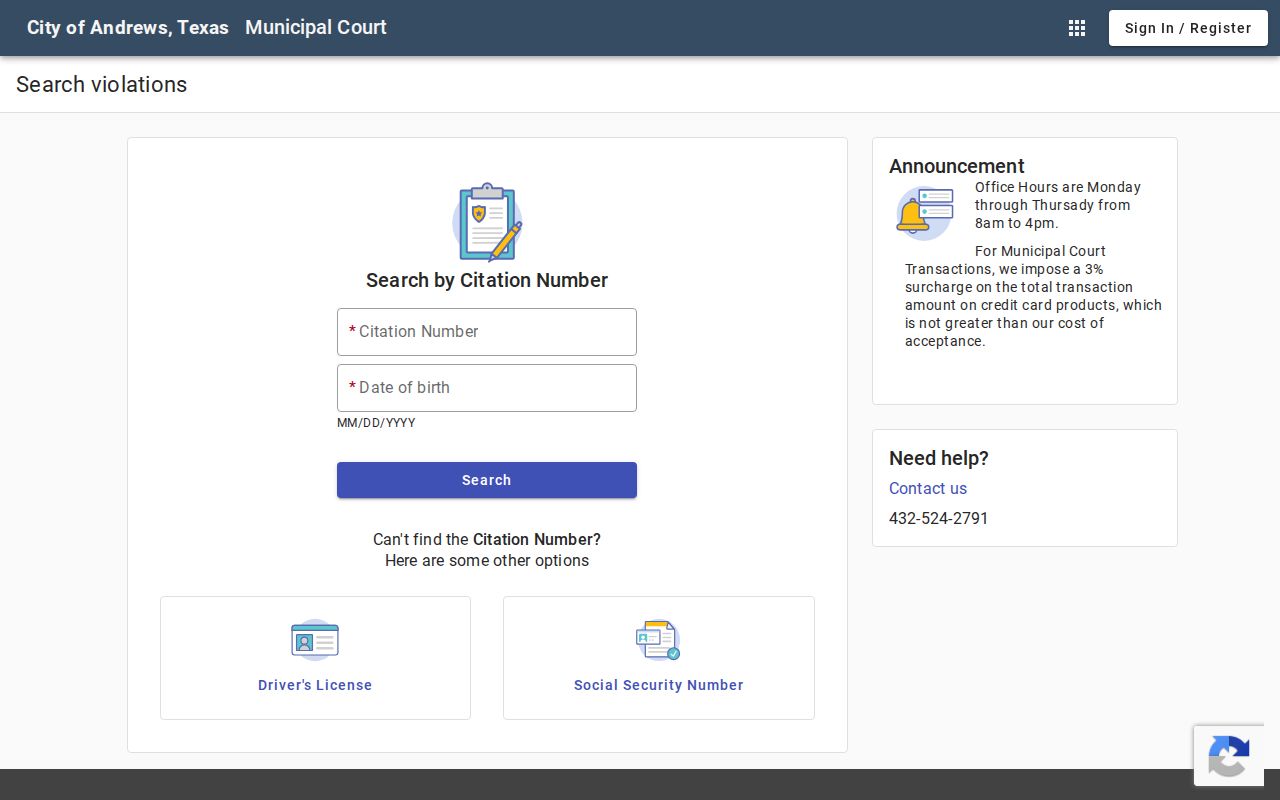
The visible fields let a person pick a narrow Andrews citation route before calling the municipal clerk for the actual record. Narrow first, then ask.
Inside the Andrews Municipal Court
The City Charter establishes the Andrews Municipal Court under state law. In the city budget, the Andrews court is described as a forum for prompt and impartial trials. Those trials cover city ordinances and Penal Code violations within municipal jurisdiction. Staffing material lists one judge, one court administrator, and a court-clerk allocation. So this is a distinct city tribunal. It is not a branch of the county clerk's office.
What belongs here? City ordinance violations and fine-only Class C matters. A felony never lands in Andrews municipal court. Nor does a county misdemeanor become a city case. The incident occurring in Andrews does not change that. Civil disputes assigned to a JP or district court stay there too. The court named on the paper controls where the first search goes.
The contact details are tangled. The city budget lists 111 Logsdon Street and the main number 432-523-4820. The portal and OCA information show 432-524-2791. They also show differing street-number text. Confirm the current Andrews court address and phone before mailing anything, paying, or showing up. With conflicting sources, verification beats guessing.
Andrews Court Records by the Numbers
Andrews is the county seat. Census place data names it the only incorporated city within Andrews County. The population figures climb steadily. They stand at 11,088 in 2010. Then came 13,487 in the 2020 Census, and a 2025 QuickFacts estimate of 13,665. The land area comes to 6.95 square miles. Remember, these numbers describe the city, not its court caseload.
The official Andrews QuickFacts source is shown in this image.
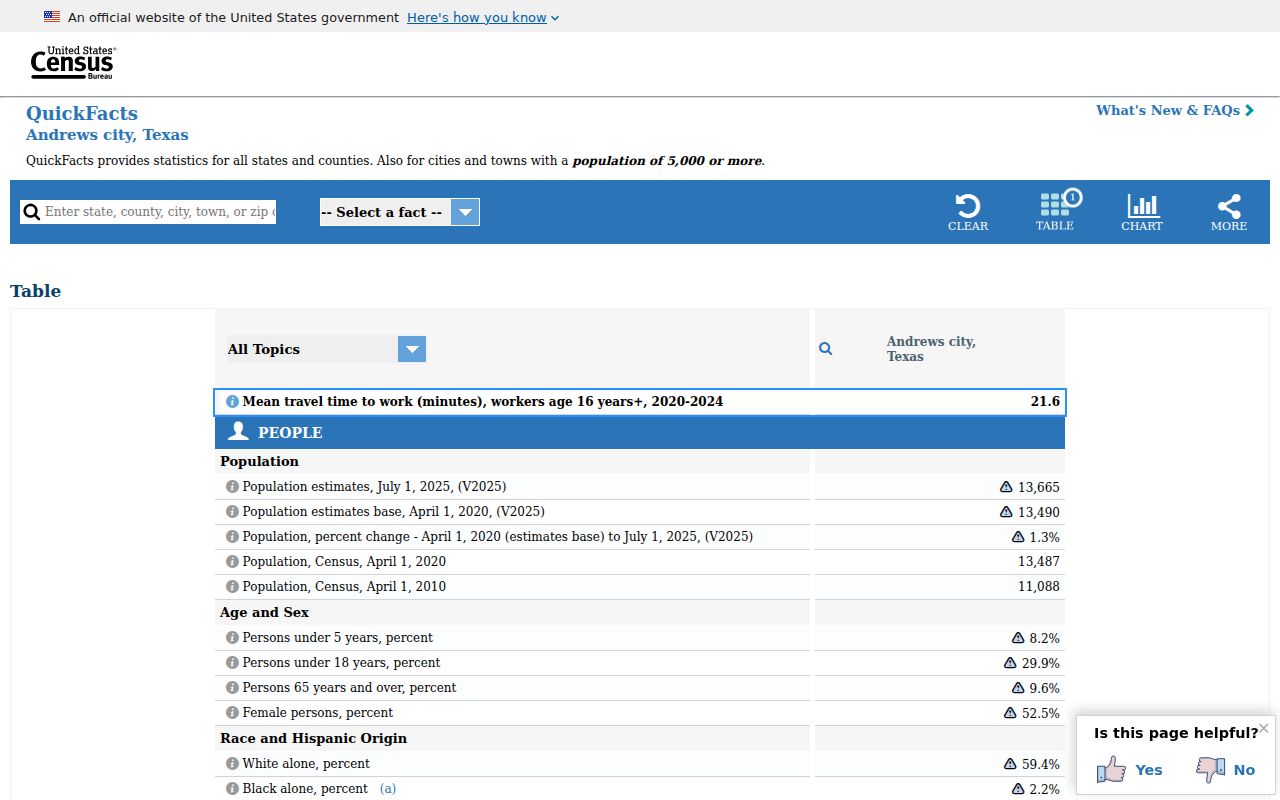
Those city figures explain why Andrews gets the sole municipal court page. They say nothing about filings, outcomes, warrants, or activity in any named Andrews record.
Finding Andrews Court Dates
Start with the citation. An Andrews case result may point to a scheduled appearance. But the court's current instruction should always be confirmed before anyone shows up. Search the Andrews portal next. Then call the Andrews court when a date is missing, looks stale, or may have shifted. One caution: a payment screen is not a full calendar. A balance alone tells you nothing about every attendance rule.
| Date | The Andrews setting date stated on the citation, notice, or current record. |
|---|---|
| Time | The appearance time supplied by the Andrews court; confirm if sources differ. |
| Location | The current city court place; verify because official contact text conflicts. |
| Court | Andrews Municipal Court, not a JP, County Court, or District Court. |
| Setting Type | The event named by the court, such as an appearance or trial setting. |
The Andrews portal notice publishes office hours of Monday through Thursday. The hours are 8 a.m. to 4 p.m. Those hours describe the office, not your case. They do not prove a hearing is set within them. Rely on the citation, the case notice, and current confirmation from the court.
Verify Andrews Court Contact Details
The contact conflict is more than a footnote. The Andrews city budget, the court directory, and the portal each present the street number and phone a bit differently. Before mailing a letter, driving over, or trusting a date given by phone, confirm the Andrews contact through the live municipal portal or the current city office.
Confirm before acting: Ask the Andrews court to verify its current address, phone, hours, citation number, and required appearance method.
When you call, write down the staff office you reached. Also note the date of the call. That small note helps if an Andrews portal notice changes later. It cannot change a deadline or override a court order. Anyone with a lawyer should also check with counsel.
Andrews Traffic Ticket Lookups
Start any City of Andrews ticket lookup with the citation number and date of birth. Those two fields give the cleanest match. The municipal portal also searches by driver license, vehicle, or name. That helps if the citation number is missing. A ticket written into JP court may never show up here at all. So check the issuing-court line on the ticket before assuming a blank result means nothing exists.
Paying and fighting a ticket are separate decisions. Anyone who plans to contest should call the Andrews court early. Ask three things: whether an appearance is required, when the appearance or trial date falls, and what filings are due. Before paying anything, confirm the full fine and costs. Confirm the card surcharge too, and whether payment counts as a plea. The portal itself starts no contest, preserves no right, clears no warrant, and promises no outcome.
The Andrews notice lists a 3% credit-card surcharge on the total transaction. It is capped by the cost of acceptance. Verify the current amount and the accepted payment methods with the court. Deferred disposition and driver-safety courses come with their own rules. So ask Andrews staff about eligibility, deadlines, required documents, and whether the request must precede payment.
Andrews Court Fee Context
The FY2023-24 city budget breaks court fees into categories. It quotes no one flat ticket price for Andrews. The list covers state and local consolidated costs, traffic fines, a child-safety fine, time-payment reimbursement, arrest and warrant fees, service charges, compliance dismissal, driver-safety-course administration, deferred disposition, expunction filing, FTA-DPS administration, and collection costs. What actually applies depends on the offense date and the court's action in the case.
Some published figures for that period include a $62 state consolidated court cost. Others are a $50 state traffic fine, a $14 local consolidated cost, a $3 local traffic fine, and a $25 child-safety fine. Other categories move more. They include a $33 to $200 deferred-disposition administration fine, plus a 30% collection fee. Treat these as budget-era references, never as a quote for a specific Andrews citation. The Andrews clerk can give the real total before you pay.
Note: A fee category in the budget does not prove that the fee applies. Check any particular Andrews case before relying on it.
How Andrews Cases Reach the County
Not everything that happens in Andrews lands on the city docket. Fine-only ordinance violations and Class C matters can stay with the Andrews Municipal Court. A county Justice of the Peace handles its own fine-only and civil cases. County misdemeanors and county-court filings run through the County Clerk. Felonies, district civil matters, and family cases belong elsewhere. They sit with the District Clerk and the 109th Judicial District Court.
Docket flow: Andrews Municipal Court › Andrews County Courts › 109th Judicial District Court
That routing describes where cases live, not how appeals travel. Jurisdiction follows the case type and the law. If the municipal portal returns no match, pin down which court issued the ticket. Do that before climbing the ladder. For the full picture across the county, see the Andrews County court docket overview.
Andrews Youth Court Record Path
Andrews Municipal Court and the Andrews County Justice Courts adopted a joint Youth Diversion Plan. The plan covers eligible non-traffic Class C cases involving children on or after January 1, 2025. It opens a front-end path that runs before any plea. The path requires written consent and stated exclusions. Traffic offenses sit outside it. The plan creates no separate public search portal for diversion matters.
Options under the plan include teen court, education, community service, counseling or screening, testing, and limited restitution. A $50 guardian administrative fee applies. A hardship waiver is available. Diversion within the prior 365 days can block the route. So can an earlier unsuccessful diversion. So can a prosecutor's objection or missing written consent. Complete it successfully and the case can close with a report. Fail, and the matter goes to a non-adversarial hearing.
Whatever appears publicly still sits in the ordinary municipal or JP record. The plan promises no separate diversion docket, and nothing in it makes private details searchable.
Who Can See Andrews Court Records
Texas law, court rules, and valid restrictions shape what the Andrews court clerk can release. Public municipal records are open to inspection or request through that office. A docket is a chronological index of case actions. It may point to a charge, a setting, a filing, an order, or a disposition. It does not show the documents behind each entry. When you ask the clerk for a docket sheet, a specific filing, or a copy, be precise. Name the case or citation precisely.
Key access rules:
Texas Rule of Judicial Administration 12 generally opens judicial records while recognizing exceptions and custodian procedures.
OCA's open-records policy explains that adjudicative records do not follow the ordinary Public Information Act route in the same way.
Texas Government Code Chapter 552 governs general public information, subject to the judicial-record boundary.
Some material stays closed no matter how you ask. Sealed records, juvenile information, protected identifiers, expunction records, mental-health information, and other confidential content may be withheld or redacted. A blank Andrews search proves nothing about whether a case exists. It could reflect a misspelled name, the wrong court, an older record, or a gap in the portal. A lawful restriction could also be the cause.
Reading an Andrews Court Record
Read an Andrews record by its labels, one at a time. The citation number marks the municipal matter itself. An issue date is not a hearing date. A setting is not a disposition. A balance shown is not the whole story of the case. Any warrant or failure-to-appear question goes back to the issuing court for a straight answer.
- Citation
- The numbered charging or notice document used to begin the Andrews lookup.
- Setting
- A scheduled Andrews court event, which may change by court action.
- Disposition
- The recorded outcome, if one has been entered.
- Reset
- A moved setting, not a dismissal or decision on the charge.
- Certified copy
- A clerk-authenticated copy, which is different from an Andrews portal screen.
When the row on screen is not enough, ask the Andrews clerk for the public order or judgment behind it. Give the exact citation, the date, and the document you want. The clerk can also tell you whether the record is public, restricted, or held by another office.
Andrews Court FTA Follow-Up
Did DPS flag a failure to appear or failure to pay? Take it up with the Andrews issuing court, not with DPS itself. The court can tell you whether an Andrews warrant or report is on file. It can also say what step clears it. That step may be an appearance, a payment, or both. Ask how the court reports your clearance to the state. DPS says updates usually take three to five business days after a court reports them.
OmniBase also lists outstanding citations for Texas. It is no substitute for the Andrews docket or the clerk's own records. Do what the court requires and keep your proof. Then give the update window time to run. Remember the limits of a payment screen. It does not show that every warrant or state record has already changed.