
Andrews County Court Docket Searches
Which court holds your Andrews County case? That question comes first. The 109th Judicial District Court hears felonies, district civil matters, and family cases. Andrews County Court covers the county-level docket. Two justice courts take fine-only criminal cases and statutory civil claims. City ordinance violations and municipal Class C matters go to Andrews Municipal Court. Federal filings live in a separate system entirely.
Bring the cause number if you have it. That number unlocks a docket search faster than anything else across clerk request screens. Without it, try exact name spellings, case type, the likely filing year, and the court. Andrews County publishes no single verified case-number format, so skip made-up prefixes.
- Identify district, county, justice, municipal, or federal jurisdiction.
- Search with the exact cause number, or combine name, date, category, and location.
- Confirm that the result names Andrews County and the correct court.
- Read the event history, then verify the latest setting or disposition.
- Ask the custodian for the actual filing or certified copy when the docket row is not enough.
Head to the official Andrews County site first, since it lists each department, court, and service route you need to reach the right office for a docket.
Treat that county site as a map, not a docket database in one place. From there, go straight to the office that holds the case.
Andrews County Docket Access Channels
Online tools cover only part of the chain. District docket work can start with the 109th court page, some files in the county archive, or re:SearchTX when that statewide service includes the civil or family matter. Criminal cases stay off re:SearchTX. County-court records belong to the County Clerk, and a municipal citation begins at the city portal. The justice courts keep separate precinct contacts.
| Channel | Best use | Limit |
|---|---|---|
| County archive | Published dockets and annual schedules | Not a complete party-name database |
| re:SearchTX | Civil, family, filings, and hearings where covered | Criminal records excluded |
| Clerk phone or counter | Coverage questions, inspection, and copies | Must reach the correct custodian |
| Mail or written request | Specific public record or copy | Needs enough detail to locate it |
You can call, visit, or ask about a mailed request. No public terminals are promised here. A Rule 12 request goes to the judicial-record custodian, while ordinary county administrative records follow the county's public-information route.
Court Dockets: What They Show
Think of a court docket as a timeline. Every entry lands in order as the case moves. Each one tracks pleadings and service through motions, hearings, orders, and judgments. What you see is the log itself, not the paperwork behind it. The full text of a filing usually lives elsewhere. Dates deserve a careful eye too. An event date, a filing date, the date a judge signed something, and the next setting can all sit on different days in the same Andrews County record.
| Cause number | The court-assigned identifier and best key for cross-checking a case. |
|---|---|
| Style or caption | The case title, subject to omission and privacy limits. |
| Case category | The criminal, civil, family, probate, juvenile, or other track. |
| Entry | A brief description of what was filed, heard, ordered, or reset. |
| Setting | The date and type of a non-jury, civil-jury, criminal-jury, or special event. |
| Disposition | A result only when the court has entered it. Pending has no final result. |
Labels matter when you read a docket entry. A motion is only a request. It is not a ruling. A reset shifts a hearing to a new date and says nothing about the claims themselves. Likewise, a service return just proves delivery or an attempt at it, never a decision on the merits. When the exact terms count, read the label closely and go find the signed document.
Andrews County Docket Portal Layers
Three separate tools, and people mix them up constantly. The County Clerk runs a Tyler portal, which is an index of official records. Think of it as a library catalogue. Its own disclaimer says it guides you to referenced documents. It is not the underlying instrument. Postings normally appear two to three business days after filing. That timing is no promise for every docket event.
The statewide layer is re:SearchTX, a court-record research service. Its documented tools cover Cases, Filings, Text, and Hearings. You can filter by party, attorney, style, docket number, location, category, and date. Coverage runs broadly through records dating from 2016. Still check any Andrews result directly. One more limit: criminal records are excluded.
Then there is eFileTexas, which is a filing layer rather than a public search service. Attorneys file through an approved provider for many district and county matters. A successful submission does not put a public image online instantly. And saving a search or alert there never creates an official copy.
Andrews County Courts and Their Dockets
Andrews County splits its courts and clerks across offices. "The clerk" can point somewhere different depending on the case. Knowing which office holds your type of filing is the first step. One wrinkle: the 109th District Court also serves Crane and Winkler Counties. Check the schedule for the right county. It must match the county tied to the event, not just the case name.
| Court | Docket covers | Where to start |
|---|---|---|
| 109th Judicial District Court | Felony, district civil, family, other district matters | District Clerk, court page, archive, re:SearchTX where covered |
| Andrews County Court | County misdemeanors, county civil, probate, guardianship | County Clerk |
| Justice Courts 1 and 2 | Fine-only offenses, debt, eviction, repair and remedy, small claims | Correct precinct clerk |
| Andrews Municipal Court | City ordinances and municipal Class C cases | Municipal citation portal or court |
The Texas court directory supplies official court and judicial listings for the county.
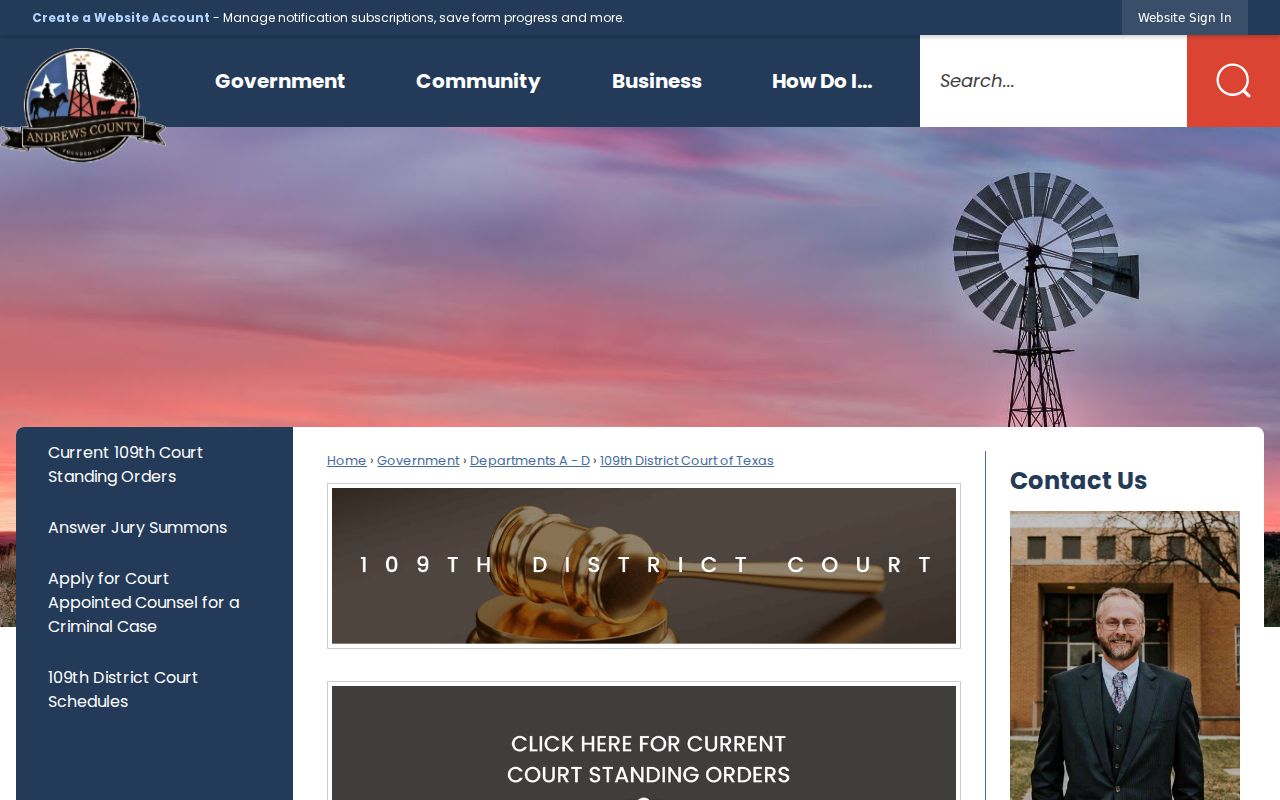
The directory confirms the named court; the local clerk remains the case-record custodian.
Andrews County Docket Terms
Every short entry in a docket has a set meaning. Read an Andrews County court docket as a running timeline, and resist the urge to draw a verdict from any single line on its own.
- Continuance
- A postponement of a hearing, trial, or other setting.
- Non-jury setting
- A court date without a jury, as labeled on the local schedule.
- Inactive
- A reporting category for a case not currently active. It is not automatic dismissal.
- Disposition
- The outcome or current resolution. In criminal reporting, it does not always mean conviction.
- Sealed or restricted
- Access limited by law, rule, or court order.
A "not found" result can mean several things. The cause may be the wrong court or precinct, a misspelled name, an older paper file, a portal gap, or a lawful limit on what the clerk can share. Retry the case lookup using the cause number, then ask the right clerk whether the public record exists.
Court Dates and Settings in Andrews County
The 109th District Court posts an annual schedule. It is built from Non-Jury, Civil Jury, Criminal Jury, and Special Setting blocks. That district covers Andrews, Crane, and Winkler. So a block alone does not prove a specific Andrews case is set. Jury dates also shift with docket conditions, and a setting can move after it appears.
Pull up the current docket and find the newest setting entry. Check it against any signed notice or order. If the date, county, time, or courtroom still seems unclear, call the court. The court administrator arranges special settings. Under the 2026 local instructions, every continuance or reset motion must say whether it is the moving party's first, second, or third such request. Temporary-order settings are capped at 30 minutes per side unless the court allows more time.
There is no recurring local Zoom link. Remote participation, when allowed, is set by order or a case notice. Never reuse an old meeting link. One more caution: a reset is not a dismissal. The annual schedule is not a court calendar for your case.
Andrews County Docket Caseload Context
The Office of Court Administration tracks court activity by fiscal year, which runs from September 1 through August 31. In FY2024, labels like added, disposed, reactivated, inactive, and active pending sort filings into administrative categories. Those labels describe paperwork status, not people and not the merits of any case.
Why does court level matter so much in Andrews County? Because the district, county, and justice courts each report their own dockets under their own rules, and a case can sit inactive or reactivated inside any one of them. So resist the urge to stack these counts into a single figure of unique cases or people; each report tracks a different court, and the numbers were never built to combine.
Docket Access Under Texas Law
Texas law leans toward openness, yet court records follow their own rules. To request an Andrews County court docket or a filed document, contact the clerk who holds the file. Describe the case. Name the record you want. Say whether you need to view it, get an ordinary copy, or get a certified copy. Keep in mind that a public docket listing does not promise that every attachment can be downloaded.
Key access rules:
Texas Rule of Judicial Administration 12 generally permits inspection and copying of judicial records, subject to exceptions.
The OCA open-records policy explains why adjudicative records differ from ordinary Public Information Act requests.
Texas Government Code Chapter 552 states the broader public-information policy and exceptions.
Texas Rules of Civil Procedure 76a and 21c address civil-record sealing and sensitive-data protection.
Clerks also have limits. They will not build a record that does not exist, and they cannot give legal advice. Sealed files, juvenile matters, mental-health cases, expunctions, personal identifiers, and similar protected material may be withheld or redacted.
Andrews County Docket History
Andrews County was created in 1876, and Andrews won the county-seat election in 1910. An early courthouse followed in 1911. The current courthouse dates to the late 1930s, with annex and remodeling work added since. This paper-centered past still shapes access, because the County Clerk holds records back to 1881 while warning that some old material is closed and not public.
Modern access is layered rather than total. District criminal, civil, and family records run on Odyssey case management. Official records sit in a Tyler-hosted portal. Older schedules and docket sheets remain in the archive, and the clerk publishes no start date for the first online docket or for when each category went digital.
So an old record may still require a clerk request. Age alone does not make a record scanned, indexed, or open. Know the difference between products too: a docket sheet, a filed document, a certified copy, and a court reporter's transcript are not the same thing.
How the Clerk Keeps Docket Records
Two offices split the workload. The District Clerk holds district civil, family, and criminal records. The County Clerk keeps county-court records. Categories cover civil, commissioners, guardianship, juvenile, mental-health, misdemeanor, and probate. Justice and municipal courts run their own lower-court dockets separately.
Andrews County District Clerk
201 N Main Street, Room 102
Andrews, TX 79714
432-524-1417
Monday-Friday, 8 a.m.-4 p.m.
Andrews County Clerk
215 NW 1st Street, Suite 121-A
Andrews, TX 79714
432-524-1426
P.O. Box 727, Andrews, TX 79714
The County Clerk's official page documents the custodian and contact information.
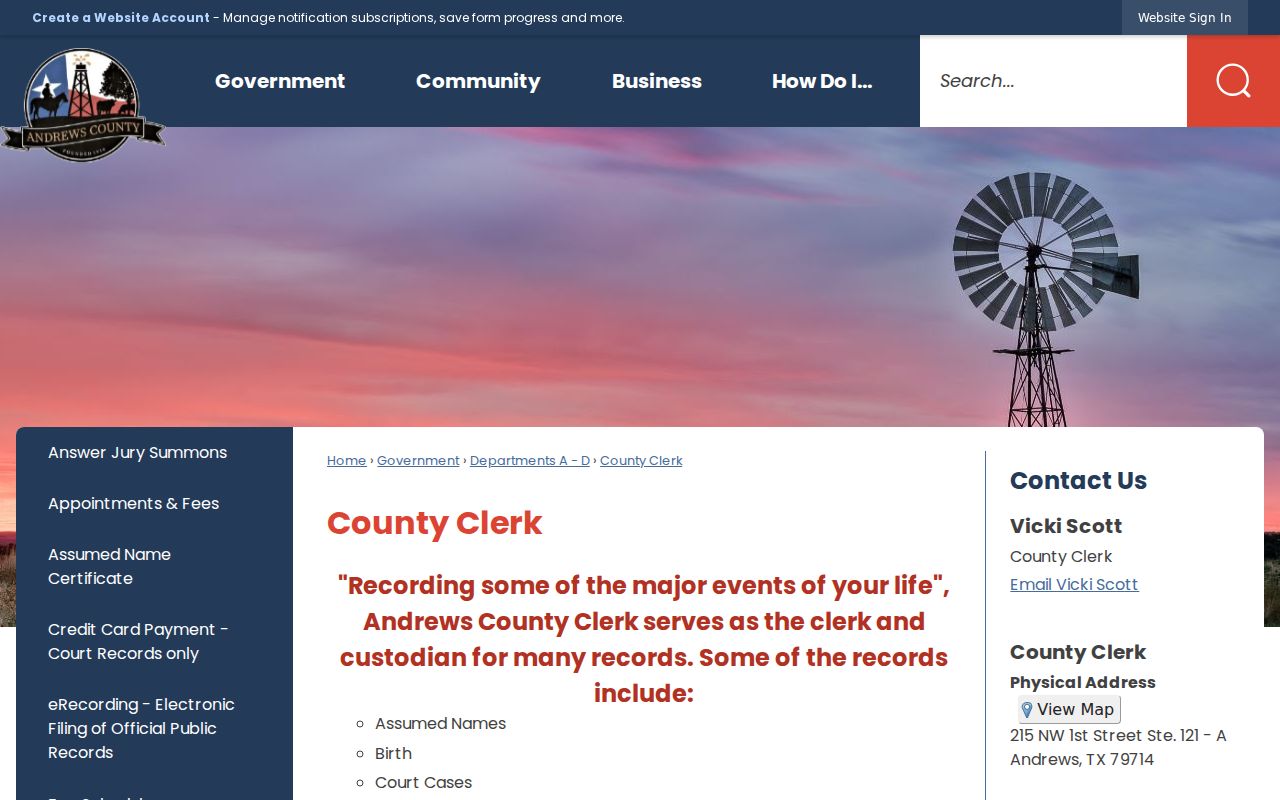
The office card can help route county-level cases. District cases, though, must go through the District Clerk.
Andrews County Docket Copy Costs
Both clerks list the same rates: $1 per page for ordinary copies and $5 per document for certification. Ask the office to confirm the current price and whether your record can be copied before you pay. Only a certified copy carries the clerk's authentication; a portal result does not.
| Item | Published amount | Practical check |
|---|---|---|
| Ordinary clerk copy | $1 per page | Ask which pages are needed |
| Certification | $5 per document | Name the exact record |
| County online card fee | 3.25%, $2 minimum | Nonrefundable provider charge |
A phone call comes first. The County Clerk's payment page requires it before you pay for a name search or court-case copies. Get a Bureau Code and a cause number first. Payment must be full. The page warns that paying without calling ahead means no refund. Filing fees are separate and should come from the office's current schedule.
The District Clerk page posts its own copy terms and civil fee headings.
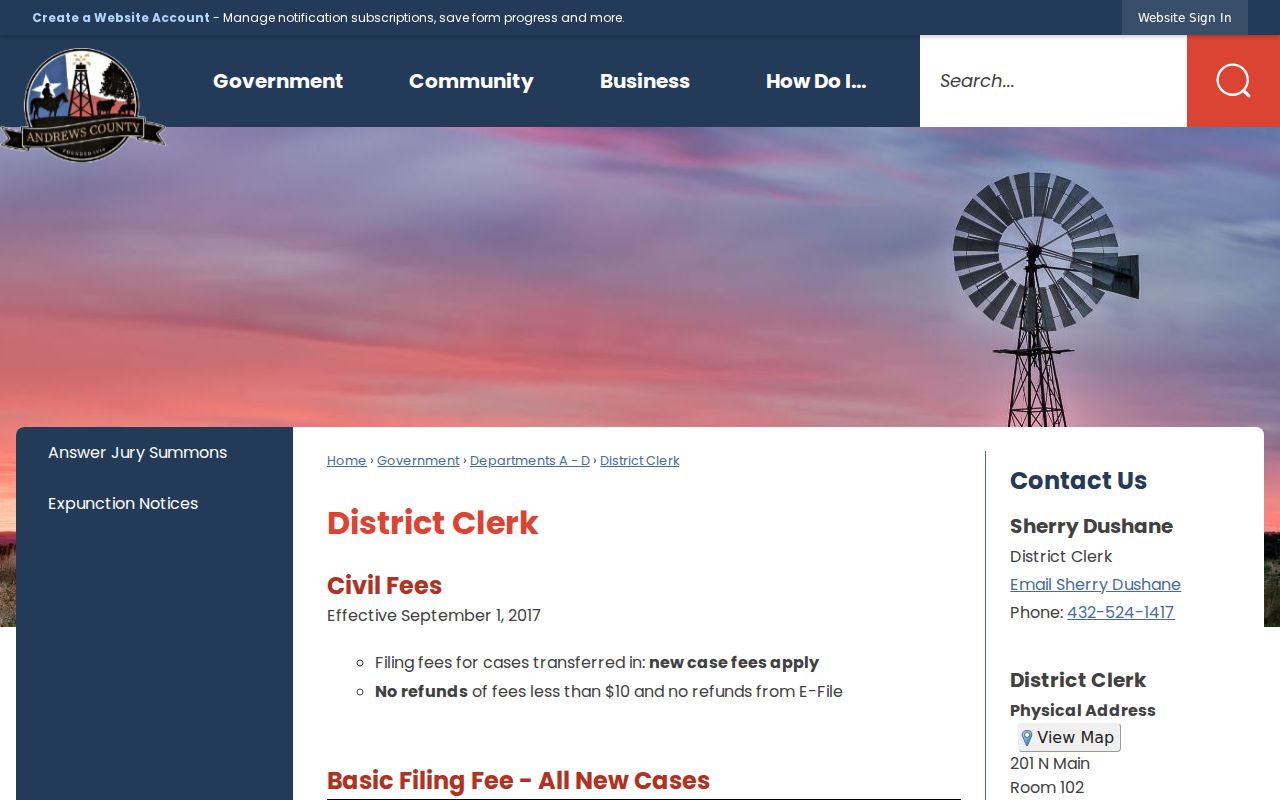
The official clerk pages lay out the local fee route, but the office must confirm what any item costs today.
City-by-City Court Dockets in Andrews County
Andrews is the county's only incorporated city, per current Census data. Rural residents file through county, district, or justice courts depending on case type. An unincorporated or historic community needs no city page of its own.
Andrews Court Records
Municipal citations and local Class C matters use the Andrews Municipal Court route. County and district matters stay with their own courts.
The municipal portal offers several search routes. One route is citation number with birth date. Other routes use driver license with state, vehicle plate with state, name with birth date, or business name. Its own official sources disagree on the street number and phone format. Verify current contact details before you pay, mail anything, or show up in person.
Andrews County Dockets Beyond State Court
A federal case touching Andrews County will not show up in the state-court docket. Andrews sits in the Midland-Odessa Division of the Western District of Texas. PACER and federal CM/ECF systems carry federal district and bankruptcy dockets. Do not confuse the two maps. The federal division is not the 109th District Court's three-county grouping.
State appeals have a general destination. District and county court cases generally go to the Eighth Court of Appeals in El Paso. From there, criminal and civil cases split toward different state high courts. An appeal opens a separate appellate docket. It carries its own cause number and filings. The trial-court docket still records notices and related activity.
Always use the court named on your paper or docket entry. A county archive search covers one set of records. A re:SearchTX query and a PACER search each cover different jurisdictions. None replaces the others.
Andrews County Docket Checkpoints
Check four facts before trusting any result. Confirm the court, the cause number, the event date, and the document type. A shared name alone can lead to the wrong record. A schedule block may belong to another county in the district. A filed motion is a request, not a ruling. A portal index is not the filed paper. These quick checks catch most search errors.
If a date is unclear, call the court that set the event. An archive image may be unreadable. A filing may be missing. In either case, contact the clerk holding the file. For a certified record, name the exact document and cause number before paying. When access is limited, ask whether the bar covers the whole case, one document, or just protected details. That answer tells you whether a redacted public copy is still available.
Map and Directions to the Andrews County Courthouse
The District Clerk keeps the district civil, family, and criminal filings for the 109th Judicial District Court out of Room 102 of the Andrews County Courthouse, 201 N Main Street, while the 109th District Court itself sits in Room 201 and the constitutional County Court is in Room 104 of the same building. The County Clerk's county-court, probate, and official-records office is in a separate building at 215 NW 1st Street, Suite 121-A.
Andrews County District Clerk
201 N Main Street, Room 102
Andrews, TX 79714
432-524-1417
Monday-Friday, 8 a.m.-4 p.m.
Andrews County Clerk
215 NW 1st Street, Suite 121-A
Andrews, TX 79714
432-524-1426
Monday-Friday, 8 a.m.-4 p.m.
The current courthouse dates to 1938-1939 and was later expanded with a 1955 annex and a 1976-77 remodel. No parking policy, security-screening procedure, or ADA request process was found in the county's published pages, so calling the District Clerk before a visit is the safer route.